Why Your Coffee Packaging Printing Method Matters More Than You Think
There’s no single best printing method for coffee packaging. There’s only the method that fits where your brand is right now.
Coffee packaging does more than protect beans. It shapes brand perception, affects how consumers judge quality, and influences whether your product feels consistent on shelf. As competition increases, printing decisions directly impact cost control, launch speed, design flexibility, and sustainability outcomes.
If you are choosing between digital and rotogravure printing, you are not picking a better option. You are choosing a tool that matches your current scale, sales velocity, and growth plans.
Digital Printing vs. Rotogravure – What’s the Real Difference
Both printing methods are widely used in coffee packaging. The difference is not quality versus compromise. It is flexibility versus efficiency at scale.
Understanding how each method works helps clarify which tradeoffs you are actually making.
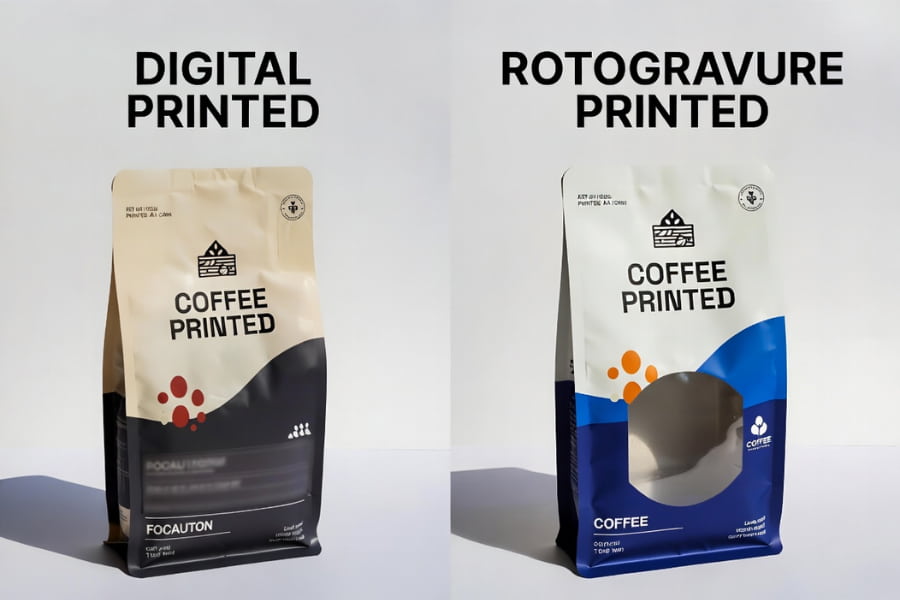
How Digital Printing Works for Coffee Packaging
Digital printing transfers artwork directly from a digital file, such as a PDF or AI file, onto packaging materials. No physical plates are required.
This method is commonly used when you are launching a new brand or SKU, running seasonal or limited releases, or refining brand identity. If you are preparing your first retail launch, digital printing is often where brands begin because it reduces upfront risk and allows faster adjustments.
How Rotogravure Printing Works at Scale
Rotogravure printing uses laser-engraved cylinders to apply ink onto packaging films with extremely high precision.
It is typically chosen when volumes are predictable, branding is locked, and color accuracy across multiple runs is critical. For brands moving from testing to long-term distribution, rotogravure becomes a strategic production decision rather than a design one.
The Key Factors That Actually Decide Which Printing Method Works
The right choice becomes clear when you evaluate the factors that matter most at your current stage.
Minimum Order Quantity – How Small Can You Start
Digital printing usually starts between 2,000 and 5,000 units, with some suppliers supporting even lower quantities. If you are ordering packaging for a new product launch or first wholesale push, this range allows you to test demand without carrying excess inventory.
Rotogravure printing typically requires 10,000 units or more, which makes sense once repeat orders and stable sales volume are established.
Cost Structure – Upfront Cost vs. Long-Term Savings
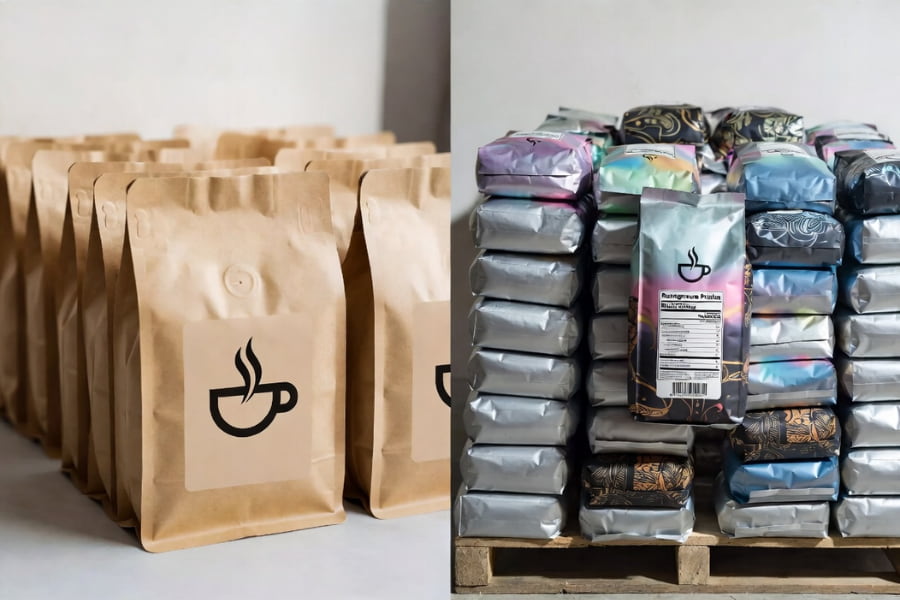
Digital printing requires no plate or cylinder fees and keeps upfront investment low. Unit costs do not decrease dramatically as volume increases, which makes it suitable for short runs and frequent changes.
Rotogravure printing involves higher initial plate costs charged per color, but delivers significantly lower unit costs at scale. When designs remain stable, the long-term savings often outweigh the initial expense.
Lead Time – How Fast You Can Get to Market
Digital printing generally takes 5 to 7 weeks, often including air shipment. Rotogravure printing usually requires 9 to 11 weeks with ocean freight factored in.
If you are working around a retail deadline, seasonal launch, or promotional window, lead time alone can determine the correct method.
Design Flexibility – How Often Can You Change Artwork
Digital printing supports full-panel printing, easy artwork updates, and efficient testing between runs. It works well when branding is still evolving.
Rotogravure printing allows fully customized bag dimensions and structures, but design changes are more expensive once plates are created. It favors brands with stable visual identity.
Print Quality – Color Consistency and Visual Impact
Digital printing delivers accurate color reproduction and handles complex graphics well, but options for metallic inks or specialty coatings are limited.
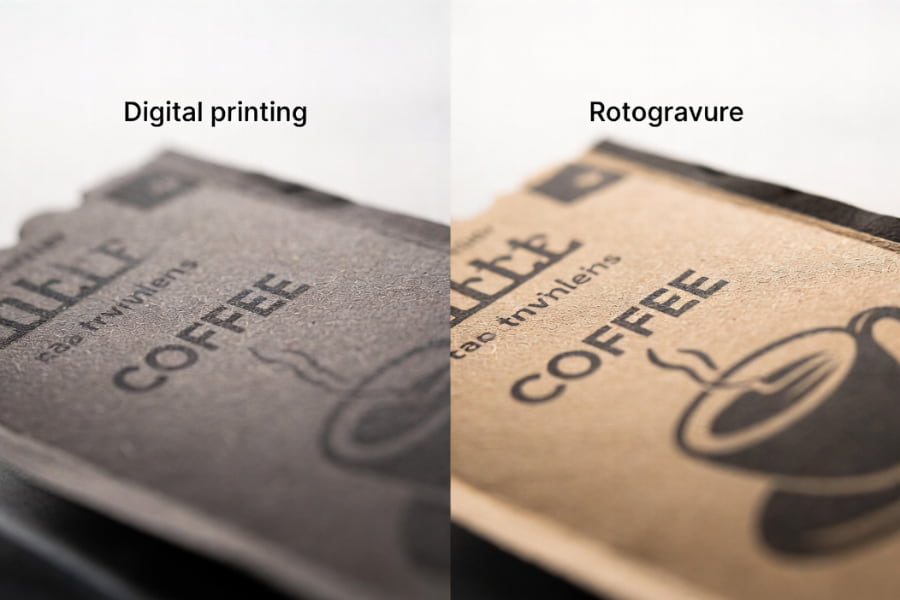
Rotogravure printing offers highly saturated colors, Pantone matching, and advanced finishes. When visual consistency is part of brand equity, rotogravure becomes a safeguard rather than a luxury.
Material Compatibility – What Films Each Method Handles Best
Digital printing works well with kraft paper, LDPE, and PLA. Rotogravure performs better on high-barrier films and specialty-coated substrates commonly used for premium coffee packaging.
Material choice often follows printing choice, not the other way around.
Sustainability – How Printing Choices Affect Environmental Impact
Printing decisions influence environmental impact as much as material selection.
Digital printing often uses low-VOC, water-based inks and eliminates the need for plates, reducing setup waste and energy use. Some systems now operate with carbon-neutral processes.
Rotogravure printing may involve higher-VOC inks depending on formulation, and plates are difficult to recycle. However, long production runs can distribute environmental impact over time.
Even recyclable materials such as kraft paper or LDPE can lose recyclability if incompatible inks are used. This is why ink, material, and end-of-life compatibility should be evaluated together rather than in isolation.
How to Choose the Right Printing Method for Your Situation
New brands and first product launches usually benefit from digital printing because it lowers risk and speeds up market entry. Seasonal or limited releases also favor digital printing due to artwork flexibility.
Stable, high-volume SKUs tend to perform better with rotogravure printing because of lower long-term unit costs and stronger color consistency. Many brands combine both approaches by using rotogravure for core products and digital printing for seasonal or experimental lines.
FAQ
Is digital or rotogravure printing better for new coffee brands?
For new coffee brands, digital printing is usually the better starting point. It supports smaller order quantities, faster turnaround times, and easy design changes. This flexibility helps brands test products, adjust branding, and validate demand before committing to large-scale production.
How expensive are rotogravure plates, and are they worth it?
Rotogravure plate costs vary by color count and design complexity, often ranging from several hundred to several thousand dollars per color. While the upfront investment is higher, plates become cost-effective when designs remain stable and production volumes increase over time.
Can brands switch from digital to rotogravure printing later?
Yes. Many coffee brands begin with digital printing and transition to rotogravure once sales volumes stabilize and designs are finalized. Although new plates are required, the lower unit cost and improved consistency of rotogravure often justify the switch as brands scale.
How can color accuracy be ensured across different print runs?
Rotogravure printing delivers the highest color consistency across large production runs. With digital printing, brands should request production samples and reference Pantone color standards. Early testing helps align expectations and avoid color variation before committing to full production.
What are the advantages of rotogravure printing for coffee packaging?
Rotogravure printing excels in color consistency, print precision, and cost efficiency at scale. It supports Pantone colors, metallic inks, and specialty finishes while delivering a lower per-unit cost over long production runs, making it ideal for established, high-volume coffee brands.
Which printing method is more sustainable?
Digital printing generally produces less setup waste and often uses low-VOC, water-based inks. Rotogravure can also support sustainability goals when paired with compliant inks and long production runs. Sustainability depends on how inks, materials, and volumes are combined, not on printing method alone.
What’s Next – Digital Printing Growth and Sustainability Trends
Digital printing continues to improve in color performance and efficiency, making it the default entry point for many small and mid-sized roasters. At the same time, sustainability requirements are accelerating innovation in low-impact inks, recyclable films, and biodegradable materials.
Hybrid strategies that combine digital printing for flexibility and rotogravure for scale are becoming increasingly common.
Final Takeaway – There’s No Best Method, Only the Right Fit
Printing decisions are not permanent commitments. They are stage-based tools.
Successful coffee brands evaluate printing choices alongside order volume, design stability, launch timelines, and sustainability goals. As these factors change, printing strategies should evolve with them.
At GAIA, teams often support brands through these transitions by matching printing methods to real-world growth stages rather than forcing a single solution. The right fit today may not be the right fit next year, and that flexibility is where smarter packaging decisions begin.


